Digital Marketing

Digital marketing is an umbrella term for the targeted, measurable, and interactive marketing of products or services using digital technologies to reach and convert leads into customers

Digital Marketing

Digital marketing is an umbrella term for the targeted, measurable, and interactive marketing of products or services using digital technologies to reach and convert leads into customers

Digital Marketing

Digital marketing is an umbrella term for the targeted, measurable, and interactive marketing of products or services using digital technologies to reach and convert leads into customers

Digital Marketing

Digital marketing is an umbrella term for the targeted, measurable, and interactive marketing of products or services using digital technologies to reach and convert leads into customers

Digital Marketing

Digital marketing is an umbrella term for the targeted, measurable, and interactive marketing of products or services using digital technologies to reach and convert leads into customers.

Showing posts with label SEO. Show all posts

Wednesday, September 16, 2015

Off Page SEO

Off-Page SEO refers to all the things that you can do directly OFF your website to help you rank higher, such as social networking, article submission, forum & blog marketing, etc.
In today’s post we will be looking specifically at Off-Page SEO and some of the most effective ways to increase your page rankings on search engines.


Off-Page Factors :-

1. Social Networking Sites :- Social Networking is bigger than ever these days! Sometimes known as “Online Reputation Management”, getting involved with social media sites is the fundamental step with which you begin to advertise, market and build your online reputation within your niche.
You need to sign up to the most popular social networking sites, such as; Facebook, LinkedIn, Twitter, Google+, etc., and create yourself a profile of your own. This allows you to extend your online network of contacts, to connect and interact with your friends, to share things with each other, and most importantly promote your website/blog and help build your online reputation.

2. Blogging :- Blogging is one of the best ways to promote your website online! By writing a blog for your website, you give a reason for visitors to keep returning to your site and keep up to date with your latest posts. It also helps search engines to crawl your site more frequently, as they have to update your latest blog post entries, which ultimately helps you rank higher in search engine results pages (SERPs).
You need to produce and include lots of unique content for your blog, such as; Infographics, Top Lists, How To…Tutorials, Viral Videos, etc. Try to remember to be clear and concise in what you are trying to convey to your readers within your blog posts, don’t waffle.
To help you promote your blog, submit it to niche blog directories and blog search engines.
If you’re not very good at writing content for your blog, then you could always hire a guest blogger for your blog and ask him/her to write precise and unique content so that your blog can gain more credit from a search engine point of view.

3. Blog Marketing :- Post comments on other blogs within the same niche as yours, which allow you to add a link in the comments section. These links can then be crawled by search engines, helping to point them towards your site.  These blogs are commonly referred to as “Do-Follow” Blogs (Just like ours, where you can comment below!).

4. Forum Marketing :- Find forums online that are related to your sites niche and get involved within that community. Reply to threads, answer peoples questions, offer advice, etc. This all helps to build up your reputation as someone who is an expert within that niche. Try to use “Do-Follow” Forums so that you can include a link to your site within your signature, which helps search engines crawl your site.

5. Search Engine Submission :- Search engines will eventually find your site online, but that can take a while. To speed everything up, you should submit your website to the most popular search engines like Google, Yahoo, Bing, etc.

6. Directory Submission :- Many people may say that directory submission is dead! I believe that it isn’t as you are increasing the likely hood of people seeing your website. It is purely based on how effectively we are selecting those directories and how efficiently we are choosing the category for submission. You could submit to general directories, but for maximum effect, you are better off submitting to niche directories. Of course, I agree that it gives quite delayed results, but it is worth doing it.

7. Social Bookmarking :- Social Bookmarking is another great way of promoting your website. Submit your latest blog posts and pages to the most popular bookmarking sites, like StumbleUpon, Digg, Delicious, Reddit, etc. Search engines really like these types of sites because the content on these sites is updated very frequently.
You should be very careful while doing this and you must properly handle the tags which are very essential to broadcast your news on a wide area network. This may increase your website traffic based on how effectively you have participated.

8. Link Baiting :- Link baiting is another popular way of promoting your site. If you produce a really popular unique post for your site, then other people may want to link to it. Perhaps you have copied/published another website’s content on your site, don’t forget to place their website link as a reference. Do it for others and, if your content is trustworthy, let others do it for you. This is another way to increase your link popularity.

9. Photo Sharing :- If you have used any of your own photos or images on your site, then you can share then on many of the major photo sharing websites like Flickr, Picasa, Photo Bucket, etc. Other people will be able to see them and comment on them, hopefully following a link to your site.

10. Video Marketing :- Just like photo sharing, if you have any videos that you have used on your site, then you can submit them to sites like; YouTube, Vimeo, etc. allowing people to find your content in other ways.

11. Business Reviews :- Write reviews about others businesses or ask your friends/clients to write a review of your business in major business review sites like RateitAll, Shvoong, Kaboodle, Stylefeeder, etc.

12. Local Listings :- Depending on your site’s niche, you might find that listing in local directories may be useful. You may have a website promoting your local business, therefore instead of going global and facing huge competition, listing your website locally, so that search engines can easily view your website and fetch the content, will be much better. This will help you to reach a targeted audience. Submit your website to sites like; Google Local, Maps, Yahoo Local, Yellow Pages, etc.

13. Article Submission :- If you write your articles yourself, then you can submit them to popular article directory sites like; Ezine, Go Articles, Now Public, etc. This can help drive traffic to your site, whilst you can also gain some links to your site from other people (though it’s usually a slower process).

14. Social Shopping Network :- If you run an e-commerce website, then a good strategy for advertising and branding your products for free is to submit then to online shopping networks. By submitting your products to sites like; Google Product Search, Yahoo Online Shopping, MSN Online Shopping, and other major social shopping network sites like Kaboodle, Style Feeder, etc. then you increase the likelihood of people finding the products that you are selling.


15. Answer Questions :- You can actively participate in answering questions on sites like Yahoo Answers. By answering and asking relevant questions on your site niche, you help to build up your reputation as someone that is an expert in your chosen field. You can place a link to your website in the source section if necessary so that people can easily find your site. If you don’t spam, this is another great way to increase your link popularity. 


Tuesday, September 15, 2015

On Page SEO

Why is On-Page SEO Important?
1. It increases your website’s overall SEO efficiency.
2. You can do it once and never spend money on it again.
3. It will ensure that your traffic is more targeted and relevant.
4. It’s completely white hat (safe)
5.It makes for good usability.


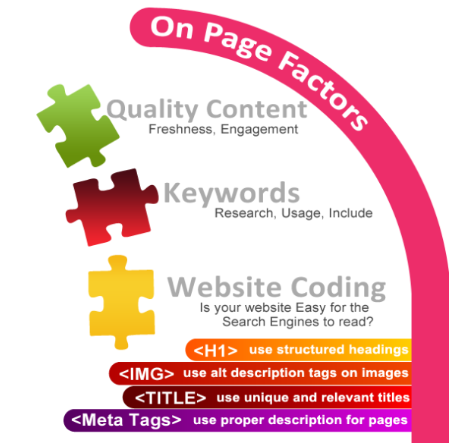
Onpage Factors :-

1. Meta Tag :- Meta tags are areas in HTML code that contain information about a website. The information cannot be seen on the website itself. Search engines access certain meta tags so they can, for instance, display a page title and description in the search results.

2. Meta Discription :- It is possible to give a short description of the content of any given webpage (e.g. homepage, subpage). This page description is laid down in HTML code and does not appear on the website. Search engines display the page description in their search results (directly underneath the page title). If a webpage does not have a page description, text from the page will often appear instead. In the search results, the search term should be emphasized in bold. Ideally the page description should contain the search term for which the website has been optimized.

3. Meta Title:- Every webpage (e.g. homepage, subpage) has its own title. The page title is laid out in HTML code and appears in the title bar of the browser. Search engines display page titles in their search results. In addition, search engines use page titles in order to recognize what information the website contains. Ideally page titles should include the search term for which the website has been optimized.

4.  Heading Tags (H1, H2, H3, H4, etc.) :-When writing your articles, you should break up your content into smaller sections & paragraphs to make it easier for people to read. These sections can be given heading, which is where H1, H2, H3, H4, etc. tags are used.
Generally H1 tags are reserved for your main page title, with subsequent headings being issued H2, H3, etc. Search engines use these to determine what is important within your content. This is why keyword rich headines are more useful than generic ones. Make sure you write keyword rich headings in the order of priority in H1, H2 and H3 title tags. They are used by many crawlers to differentiate important content.

5. Image Optimization / Alt Tag :- It refers to use alt tags properly. Using alt tags with every image will help you to get traffic from image search as well.

6. Canonicalization :- Url Duplicacy, if not solved then can harm your website. It happens because one don’t redirects the unnecessary page that show the same data which is somehow considered as duplicate data by search engine bots.

7. Robots.txt Optimization :- It a file which tell the search engine bot that which place to crawl and which to not.

8. Text Modification Optimization :- Text optimization also plays important role in ranking better in SERP. One must apply the keyword density rule to gain more benefits from their site.

9. W3C Validation :- With help of W3C you can validate your website to make sure that it is up to dated and working fine according to the latest rules of programming.

10. URL Structure :- Including search engine friendly URLs for each of your pages is highly recommended, as these bring better crawling. Shorter URLs seem to perform better in search engine results, however that is not the only factor.URLs that include targeted keywords, also perform better. The location of these keywords can also be a major influence.

11. Link to other posts and pages :- Link internally within your site to important posts and pages. This keeps Googlebot on your site longer, which means more pages get crawled on your site. It also helps improve visitor “time on site” — meaning more opportunities to convert traffic into conversions.

12. Improve pagespeed :- A fast website is one of the quickest (no pun intended) paths towards better conversions. Google measures bounce rate and dwell time. A slow website impacts the user experience, and therefore can ding you in the SEO department. The speed of your server is just one more factor that plays into good on-page SEO. A fast website is a must-have.
There are a number of things you can do to speed up your website.

Minimize HTTP Requests
Reduce server response time
Enable compression
Enable browser caching
Minify resources
Optimize images
Optimize CSS Deliver
Prioritize above-the-fold content
Reduce the number of plugins you use on your site
Reduce redirects

13. Duplicate Content :- Duplicate content refers to several websites with the same or very similar content. Search engines aim to give the user the best search results for a particular search term and consider it to be unhelpful when exactly the same content appears in several places. For this reason search engines check for duplicate content and give less consideration to websites that have duplicate information.


14. Sitemap.xml :- The sitemap.xml file in an XML file that is saved to a website’s server. It contains a list of all the subpages belonging to the website. These files help search engines to learn more about the structure of a website. This speeds up the crawl process and reduces the likelihood that the crawler will overlook subpages.

Monday, September 14, 2015

Types of SEO Techniques

Optimization of websites is a very important strategy to deliver the best results. SEO or search engine optimization using the best proven strategies helps to make business websites appealing to search engines. This in turn improves the ranking and enables the website to appear among the top ranking websites on search engine result pages.

SEO techniques can be classified into two groups:
1. On page SEO
2. Off page SEO

On page SEO deals with aspects on your website that can be optimized for search engines. Off page SEO involves aspects on other websites on the internet that can be optimized to improve the ranking of your website on leading search engines. It's important to understand the difference between on page and off page SEO.

On page SEO
On page SEO is what you do on your own website or blog in order to enhance the traffic. It is the first thing that every webmaster should look into. On page optimization needs constant revision of the site in order to improve and maintain the ranking. In this technique, the role of keywords or key phrases that the user might type has a prominent position. It includes headings, page titles, domain names and images. But all these elements have to be search-engine friendly. The size of the site should not be too large or too small. It should have genuine, interesting and relevant content. The main components involved in on-page optimization are listed below:
- Headings
- Title of the page
- Meta description and tags
- Image and pictures
- URL structure and domain information
- User-friendly navigation and quick loading
- Fresh and quality content
- Optimized external and internal links
Off page SEO
Unlike on page optimization, off page depends on another web page to improve your site or blog. Off-page optimization deals with link building factors. It's an ongoing process and needs regular new links that are given priority by search engines. In this technique if you obtain a high quality link, then your site can rank higher. Strategic link building increases the traffic to your website and its position in Google.
Off page SEO is a combination of social media, social bookmarking and link building.

Which One is More Important? 
There’s no clear-cut formula for choosing between on and off-page SEO- and luckily, you don’t have to. On-page and off-page SEO work together to improve your search engine rankings in complementary fashion; however, SEOs generally advise getting your on-page SEO ducks in a row before focusing too much on off-page SEO. Review your website’s analytics to figure out which aspects of on- and off-page SEO you should focus your short-term and long-term SEO efforts on. Balancing the two will help make your website “bilingual” so that your users can understand it as well as the search engine robots- and that’s how your rankings start to improve


Saturday, September 12, 2015

Types of SEO

As the colors of the types of search engine optimization suggest, there are stark differences in the approach and long-term results of white hat , grey hat and black hat search engine optimization. Though types of SEO have their proponents, most companies/websites with long-term, stable, and sustainable goals will tend to stay away from the dark-colored variety.

1. White Hat SEO
White hat SEO is the technique to follow the rules of a search engine, and ensure that the article that we post are our own and in accordance with the title, this will increase our ranking in search engines, visitors will see it and will return again. white hat seo is likecreating content for the search, not for search engines by making content easilyaccessible to the spiders.

2. Black Hat SEO
Black hat SEO is a technique which is the opposite of white hat SEO, which is trying toimprove website ranking in search engines in ways that are not allowed to search engines,such as cheating or breaking the scatter machine.

3. Grey Hat SEO
Grey hat SEO (not white and not black but gray) is a technique that does not fully use the second technique above, or maybe combine the two. Perhaps this is also the transformation from white to black ato black to white. It could be argued, this technique is atechnique that uses black hat techniques to achieve results white hat)

Here we have the differences between the two most important techniques :-

White Hat SEO
Black Hat SEO
Definition
White hat SEO utilizes techniques and methods to improve the search engine rankings of a website which don't run afoul of search engine (mainly Google) guidelines.
Black Hat SEO exploits weaknesses in the search engine algorithms to obtain high rankings for a website. Such techniques and methods are in direct conflict with search engine guidelines.
Wholesomeness Level
High
Very Low (not wholesome at all if you ask those in charge of cleaning search engine result page spam)
Techniques
Some white hat SEO techniques include: high quality content development, website HTML optimization and restructuring, link acquisition campaigns supported by high quality content and manual research and outreach.
Some black hat SEO techniques include: link spam, keyword stuffing, cloaking, hidden text, and hidden links.
What to Expect
Steady, gradual, but lasting growth in rankings.
Quick, unpredictable, and short-lasting growth in rankings.


Friday, September 11, 2015

Introduction To SEO

Search Engine Optimization (SEO) is the activity of optimizing web pages or whole sites in order to make them search engine friendly, thus getting higher positions in search results.
SEO is a marketing discipline focused on growing visibility in organic (non-paid) search engine results. SEO encompasses both the technical and creative elements required to improve rankings, drive traffic, and increase awareness in search engines. There are many aspects to SEO, from the words on your page to the way other sites link to you on the web. Sometimes SEO is simply a matter of making sure your site is structured in a way that search engines understand.
SEO isn't just about building search engine-friendly websites. It's about making your site better for people too.

Common search engine principles
To understand seo you need to be aware of the architecture of search engines. They all contain the following main components:

Spider - a browser-like program that downloads web pages.
Crawler – a program that automatically follows all of the links on each web page.
Indexer - a program that analyzes web pages downloaded by the spider and the crawler.
Database – storage for downloaded and processed pages.
Results engine – extracts search results from the database.
Web server – a server that is responsible for interaction between the user and other search engine components.

Specific implementations of search mechanisms may differ. For example, the Spider+Crawler+Indexer component group might be implemented as a single program that downloads web pages, analyzes them and then uses their links to find new resources. However, the components listed are inherent to all search engines and the seo principles are the same.

How Search Engine Works?
Search engines perform several activities in order to deliver search results
1. Crawling - is the process of fetching all the web pages linked to a web site. This task is performed by software, called a crawler or a spider (or Googlebot, as is the case with Google).

2. Indexing - is the process of creating index for all the fetched web pages and keeping them into a giant database from where it can later be retrieved.  Essentially, the process of indexing is identifying the words and expressions that best describe the page and assigning the page to particular keywords.

3. Processing - When a search request comes, the search engine processes it . i.e. it compares the search string in the search request with the indexed pages in the database.

4. Calculating Relevancy - Since it is likely that more than one pages contains the search string, so the search engine starts calculating the relevancy of each of the pages in its index to the search string.

5. Retrieving Results - The last step in search engines' activities is retrieving the best matched results. Basically, it is nothing more than simply displaying them in the browser.